Duolingo AI: Designing Adaptive Learning with AI

OVERVIEW
As a user of Duolingo myself, I appreciate how the app fosters a fun and approachable experience in learning new languages through short lessons and gamification. However, the lesson plans are mostly predefined and does not fully adapt to the individual user's strengths and weaknesses. This project explores how AI could transform Duolingo into a more personalized learning experience by identifying learning gaps and generating targeted practice while maintaining user trust, transparency, and control.
My Role
Product Designer
Tools
Figma
FigJan
ChatGPT
Claude
DEFINING THE PROBLEM
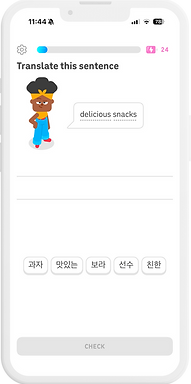
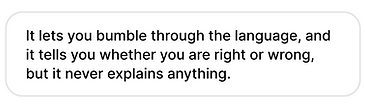
Duolingo users often encounter linguistic concepts they repeatedly struggle with, whether it regards grammatical concepts of sentence structure, yet most learning paths remain largely predefined. While review exercises help reinforce material, they don't always address why a learner is struggling or adapt instruction to the user's individual learning needs. Language learners don't need more practice, they need the right practice.


HOW MIGHT WE?
How might we create a language learning experience that adapts to each learner's unique strengths and weaknesses while maintaining trust and transparency?
DESIGINING AN AI EXPERIENCE
-
Incorrect answers
-
Response time
-
Speaking accuracy
-
Forgotten vocabulary
-
Grammar mistakes
What the AI is Looking For
-
Detect learning gaps
-
Generalize personalized lessons
-
Adjust review schedules
-
Recommend explanations
-
Adapt difficulty
How the AI Responds
Should
-
After repeated mistakes
-
At the end of a lesson
-
During weekly progress reviews
-
A learner who's in flow
-
Changing lessons without permission
-
Overwhelm users with suggestions
Shouldn't
When Should and Shouldn't AI Intervene?
FEATURES
Personalized Lesson Generator
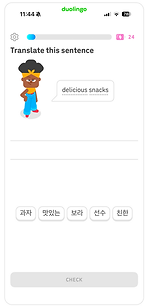
The AI will create a lesson based off concepts the user struggles with, vocabulary they forget, mistakes from recent lessons, and topics the user is interested in. This way, instead of every learner receiving the same lesson, everyone can get their own personalized lesson.

Learning Insights
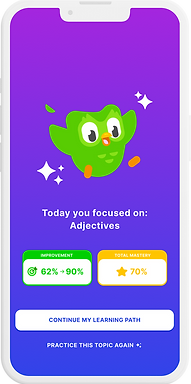
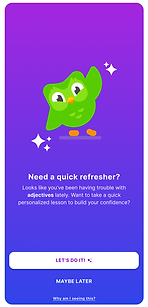
Instead of the usual XP statistics, users will be able to view their topic mastery after AI lessons to give users visibility of their learning status. In their profile, they should be able to review their overall accomplishment in different topics for actionable feedback.
Mastery status after users complete AI lesson

Users can view their progress in their profile and choose to take an AI generated lesson
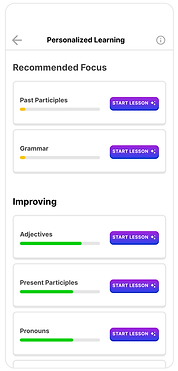
Explanation
AI should explain why users are making mistakes in order to foster their learning. AI should be able to identify patterns in mistakes the user makes and adapt their explanation to fit different users learning style.


DESIGNING TRUST
User Control
AI should never be forced onto the user and choices should be offered instead. This allows users to feel in control of their experience.

Users can choose to continue with the original lesson plan or to start an AI generated lesson
Transparency
It's important that we are transparent about why the users' lessons have changed so the users understand what is happening.

Users should be kept in the loop about why their lessons were changed and what is being targeted
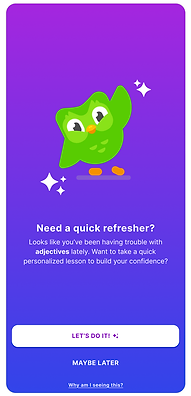
Users should be given the option to start the AI lesson, deny the lesson, and understand why it's being offered
Privacy
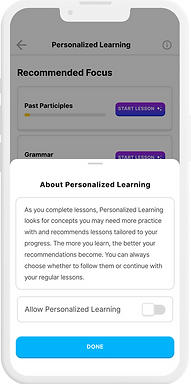
Language learning is personal. Let users decide if they want their learning experience to be personalized.

Users should have the freedom to toggle on/off the AI lessons
DUOLINGO AI USER FLOW